30-Second Executive Summary
As consumer electronics push toward thinner, lighter, and denser assemblies, production equipment faces severe space constraints and micron-level tolerance demands.
T-SENSE Precision Micro Switches (BCW / BCS contact positioning series) achieve 0.001mm repeatability, consume zero standby power, and remain completely immune to target material, color, or surface gloss — delivering 100% reliable mechanical datum detection across semiconductor handling, smartphone assembly, automated dispensing, and line poka-yoke.
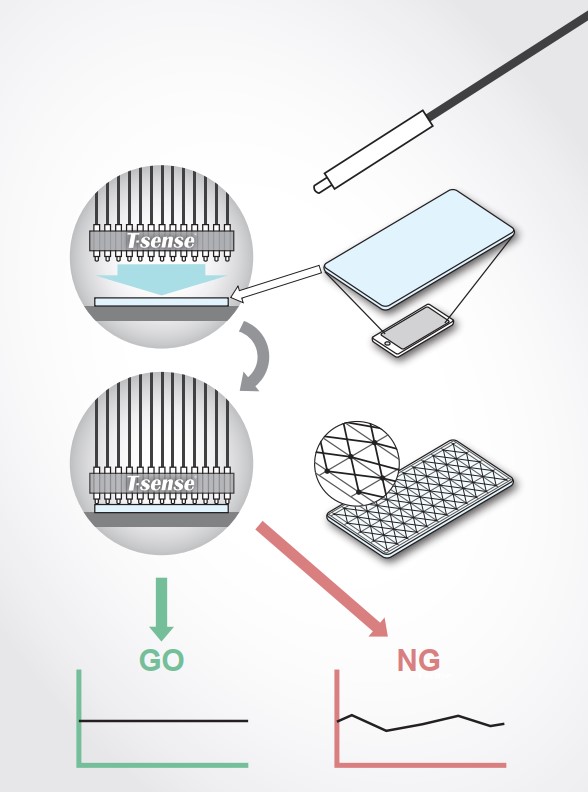
1. Semiconductor & PCB Packaging Inspection
During wafer handling and circuit board (PCB) assembly, equipment must confirm datum positions with micron accuracy to avoid damaging high-value dies or substrates.
PCB Drilling & Routing Machines
Precision contact switches verify drill bit and router Z-axis datum heights. Because PCB laminates naturally exhibit minor warpage, direct mechanical sensing establishes an exact surface reference to prevent shallow blind vias or breakthrough defects.
Wafer Handling Robots
Inside cleanroom and vacuum equipment, compact M5-class T-SENSE probes fit directly onto tight end-effectors to verify chuck or fixture seating without disturbing laminar airflow.
2. Smartphone & Wearable Device Assembly
Highly automated smartphone lines rely on precision micro switches as mechanical tactile references for sub-millimeter assembly tolerances.
- Display Bonding Gap Control: Confirms exact press stroke and Z-stop height so fragile OLED glass is sealed cleanly without over-compression.
- Camera Lens Module Alignment: Establishes repeatable home positions for focus rings and multi-element lens barrels, eliminating batch-to-batch drift.
- Tactile Button Stroke Testing: Serves as an objective mechanical datum during automated force-stroke quality inspection of side buttons.
3. Automated Dispensing & Conformal Coating
Micro-dispensing valves for chip underfill and miniature inductors require exact Z-clearance between needle tip and substrate — too high causes dot offset, while too low crashes delicate needles.
Automated Needle Tip Calibration
Extending T-SENSE's CNC tool setter technology into electronics assembly, precision micro switches locate the exact Z-axis coordinate of dispensing needle tips after replacement, ensuring consistent adhesive volume and eliminating needle crash downtime.
Cross-Industry Engineering: Locating a fine dispensing needle tip is physically identical to probing a micro CNC end mill — both require feather-light contact force and 1μm repeatability.
4. Production Line Poka-Yoke & Axis Homing
When verifying the presence of miniature inductors, capacitors, or dark housings on a fixture, infrared sensors can fail due to specular reflection or color variation, inductive sensors detect only metals, and capacitive sensors drift with humidity. Contact-type switches detect every solid material identically, consume zero standby current, and hold their zero datum after power outages.
Core Competitive Advantages of T-SENSE BCW / BCS Switches
0.001mm Repeatability
C-grade switches achieve true micron-level repeatability required by tier-one semiconductor and mobile supply chains.
Total Immunity to Reflections & Oil Mist
Mechanical switching is unaffected by glossy wafers, dark plastics, cooling mist, or EMI noise.
Ultra-Compact M4 / M6 Housings
Slim cylindrical BCS housings fit seamlessly inside congested pick-and-place heads and PCB fixtures.
Zero Standby Power & Instant Response
Zero power draw when idle and simple hardwired switching with no electronic signal processing lag.
Frequently Asked Questions
Summary
Combining tungsten carbide styli, SUS303 stainless steel bodies, and IP67 sealing (BCW series), T-SENSE precision micro switches give electronics equipment builders higher repeatability and reliability than optical or proximity alternatives.
Explore T-SENSE Precision Contact Positioning Switches
Compare BCW waterproof (IP67) and BCS ultra-compact series specifications or request engineering samples.
View BCW / BCS Specifications