Hidden Crash Risks During Tool Setting: Are You Aware?
In CNC machining, the spindle is undeniably the most expensive core component. Have you ever considered that daily tool setting routines conceal severe crash risks?
Typically, when the spindle feeds a tool downward to touch the tool setter, the system relies on the trigger signal (Skip Signal) to stop movement. However, if cable aging causes breakage, or coolant and oil contamination lead to contact failure, missing this critical signal causes the spindle to continue plunging like a car with failed brakes, leading to a catastrophic collision.
Risk Alert: Skip Signal failure is not uncommon in machine shop environments—cable fatigue, coolant ingress, and connector corrosion can all trigger it. Without overtravel protection, spindle rebuilds cost tens of thousands of dollars alongside immense downtime losses.
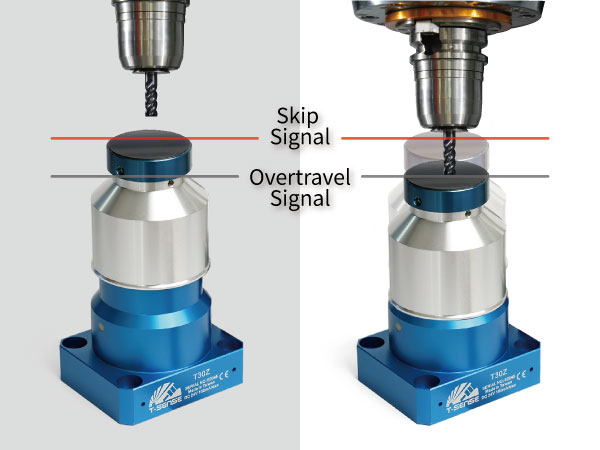
▲ T-SENSE Tool Setter Signal Protection: Skip Signal (1st line of defense) & Overtravel Signal (2nd line of defense) dual protection mechanism
Upgrading Insurance for High-Value Equipment: T-SENSE Overtravel Protection
The difference between having overtravel protection and not lies in fault tolerance when accidents occur. To provide greater peace of mind, select advanced T-SENSE tool setter models incorporate a dedicated overtravel protection device (utilizing an NC Normally Closed switch design). If the primary signal fails and the spindle continues downward to trigger the underlying overtravel switch, the tool setter immediately commands the CNC system to initiate an "Emergency Stop".
These few millimeters of advanced safety mechanism can save you tens of thousands in spindle repair costs and precious production uptime.
Safety Advantages of the NC (Normally Closed) Switch Design
- Fail-Safe Wire Break Alarm: The NC normally closed switch remains conductive under normal conditions. If a wire breaks, the system immediately senses an anomaly and triggers a fault, preventing protection loss due to broken wires.
- Instantaneous Response: The instant the spindle contacts the overtravel switch, the circuit breaks, sending an E-stop signal with near-zero latency.
- Dual Independent Redundancy: Together with the Skip Signal, it forms two independent protective layers where each acts autonomously.
Superior Safety Margin: T-SENSE Exclusive "Braking Buffer Allowance"
While other competitor products on the market claim to offer overtravel protection, they frequently overlook a fatal real-world blind spot: CNC machine system braking response delay.
When the spindle triggers an overtravel switch, if the CNC braking reaction time is slightly delayed, spindle inertia causes it to continue downward. Most competitor designs fail to account for this; even though an E-stop signal is issued, delayed stopping still results in a crash, destroying both spindle and tool setter.
T-SENSE thoroughly considers real-world machining dynamics, incorporating dedicated overtravel braking buffer distance into the mechanical structure. Even with minor CNC braking latency, this meticulously calculated safety margin absorbs remaining downward travel, delivering flawless 100% anti-crash protection.
T-SENSE Exclusive Advantage: Combining overtravel protection with mechanical braking buffer distance provides not only a secondary electrical signal defense, but also the ultimate physical cushion—a crucial advantage that competitors lacking buffer space cannot match.
Three Protection Levels Compared: Clearly Identify Your Risk
| Protection Level | Applicable Products | When Skip Signal Fails | During Braking Delay | Crash Risk |
|---|---|---|---|---|
| No Overtravel | Standard basic tool setters | Spindle continues plunging | No protection | Extremely High |
| Overtravel (No Buffer) | Most competitors | Triggers E-Stop signal | Crash still possible | Moderate |
| T-SENSE Overtravel + Buffer | T-SENSE Advanced Models | Triggers E-Stop signal | Absorbed by buffer space | Extremely Low (Near Zero) |
Conclusion: A Few Millimeters Decide the Fate of Your Spindle
When safeguarding high-value CNC machinery, tool setter overtravel protection is not an optional luxury—it is the ultimate defense line for spindle security. T-SENSE advanced models combine NC normally closed overtravel switches with exclusive mechanical braking buffer space, achieving comprehensive protection from electrical signals to physical structure.
Choosing a T-SENSE advanced tool setter with comprehensive overtravel protection means securing the most reliable safety net for your CNC spindle. Explore more T-SENSE tool setter series on our Product Overview page, or contact us directly for expert model selection assistance.
Want to know which T-SENSE tool setter models feature overtravel protection?
Contact T-sense today! Based on your machine model and machining requirements, we will recommend the optimal T-SENSE tool setter protection solution.
Contact Us for Expert ConsultationFrequently Asked Questions (FAQ)
Q:What is the difference between tool setters with and without overtravel protection?
The primary difference is whether there is an ultimate safety defense against spindle crashes. Under normal conditions, all tool setters use the Skip Signal upon contact to stop the spindle. Without overtravel protection, if the Skip Signal fails due to cable aging or contamination, the spindle keeps descending and crashes. T-SENSE advanced models feature a secondary defense (NC switch) and exclusive braking buffer space, immediately triggering an E-stop while providing sufficient physical cushion to completely eliminate crash risks.
- Normal Operation (All tool setters): Tool contacts the touch plate, generating a Skip Signal to stop spindle descent normally.
- Risk Without Overtravel: If the signal fails to transmit, the spindle plunges directly into a catastrophic crash.
- Competitor Blind Spot (Standard Overtravel): Although a second switch exists, lack of braking buffer space still results in crashes due to CNC deceleration latency.
- T-SENSE Overtravel + Braking Buffer: Built-in NC switch plus exclusive physical braking allowance. If the primary signal fails, it immediately triggers an E-stop and absorbs inertia, stopping crashes completely.
Q:Why does tool setter overtravel protection require a "braking buffer allowance"?
When the spindle triggers an overtravel switch, machine deceleration and electrical response introduce a slight delay, during which inertia carries the spindle further downward. Most competitor products overlook this distance, so crashes still occur before the spindle comes to a full stop. T-SENSE designs a dedicated braking buffer stroke into the mechanics, absorbing residual downward travel even during braking delays for true 100% crash protection.
Q:What causes a tool setter's Skip Signal to fail?
Common causes of Skip Signal failure include cable wear and fatigue breakage, coolant or cutting oil ingress causing contact contamination, connector loosening or corrosion, and severe electrical noise. These issues are frequent in industrial CNC environments; without overtravel protection, they lead directly to disastrous spindle collisions.
Q:What switch design does T-SENSE use for overtravel protection, and what is its advantage?
T-SENSE utilizes an NC (Normally Closed) switch design. NC circuits remain closed/conductive during normal operation and open upon trigger. This delivers a "fail-safe" broken-wire alarm: if the overtravel circuit wire is severed, the CNC system immediately detects the fault and stops, offering far greater safety redundancy than NO (Normally Open) switches.