📋 30-Second Quick Summary
A traditional Z-axis presetter is a purely mechanical measuring instrument relying on visual interpretation of dial graduations, with repeatability of only +/-0.02mm and no waterproof or dustproof protection, requiring storage in a temperature- and humidity-controlled environment.
The T-SENSE tool setter is an electro-mechanical integrated design with repeatability of 0.0006mm (0.6um), featuring a waterproof and dustproof sealed structure for permanent on-machine installation, supporting automation integration, completing tool setting in approximately 10 seconds, and safely measuring micro tools down to 0.05mm.
These are not incremental improvements of the same generation—they are cross-generational products based on fundamentally different physical principles.
| Comparison Dimension | Traditional Z-Axis Presetter | T-SENSE Tool Setter |
|---|---|---|
| Physical Design & Principle | Mechanical dial / test indicator, gear-spring transmission | Electro-mechanical integration, electronic sensor + LED indicator |
| Readout Method | Visual interpretation of dial graduations, susceptible to parallax and operator fatigue | LED indicator or automated signal output, zero human error |
| Repeatability | +/-0.02mm (best case) | 0.0006mm (0.6um) micron-level |
| Tool Setting Cycle Time | Several minutes (manual full workflow) | Approx. 10 seconds (with automated macro integration) |
| Environmental Tolerance | Unsealed, vulnerable to cutting fluid and dust, requires metrology room storage | Sealed waterproof and dustproof structure, permanently mountable on machine table |
| Long-Term Stability | Gear wear, spring fatigue, requires periodic calibration and maintenance | Precision linear bearing, no friction backlash, excellent stability |
| Minimum Measurable Tool Diameter | Limited by high contact force; cannot measure micro tools | 0.05mm ultra-small tools (custom spec); 0.07mm standard |
1. Physical Design and Operating Principle
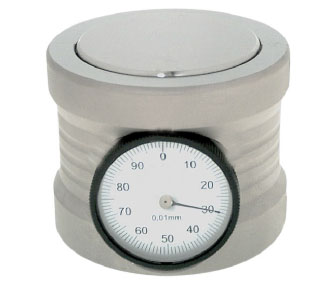
The traditional Z-axis presetter is built around a mechanical dial indicator or test indicator, featuring a graduated dial face that visually resembles a small platform scale. Internally, it comprises gears, racks, and springs, converting the vertical displacement of the tool upon contact with the platform into angular displacement of the pointer for display.
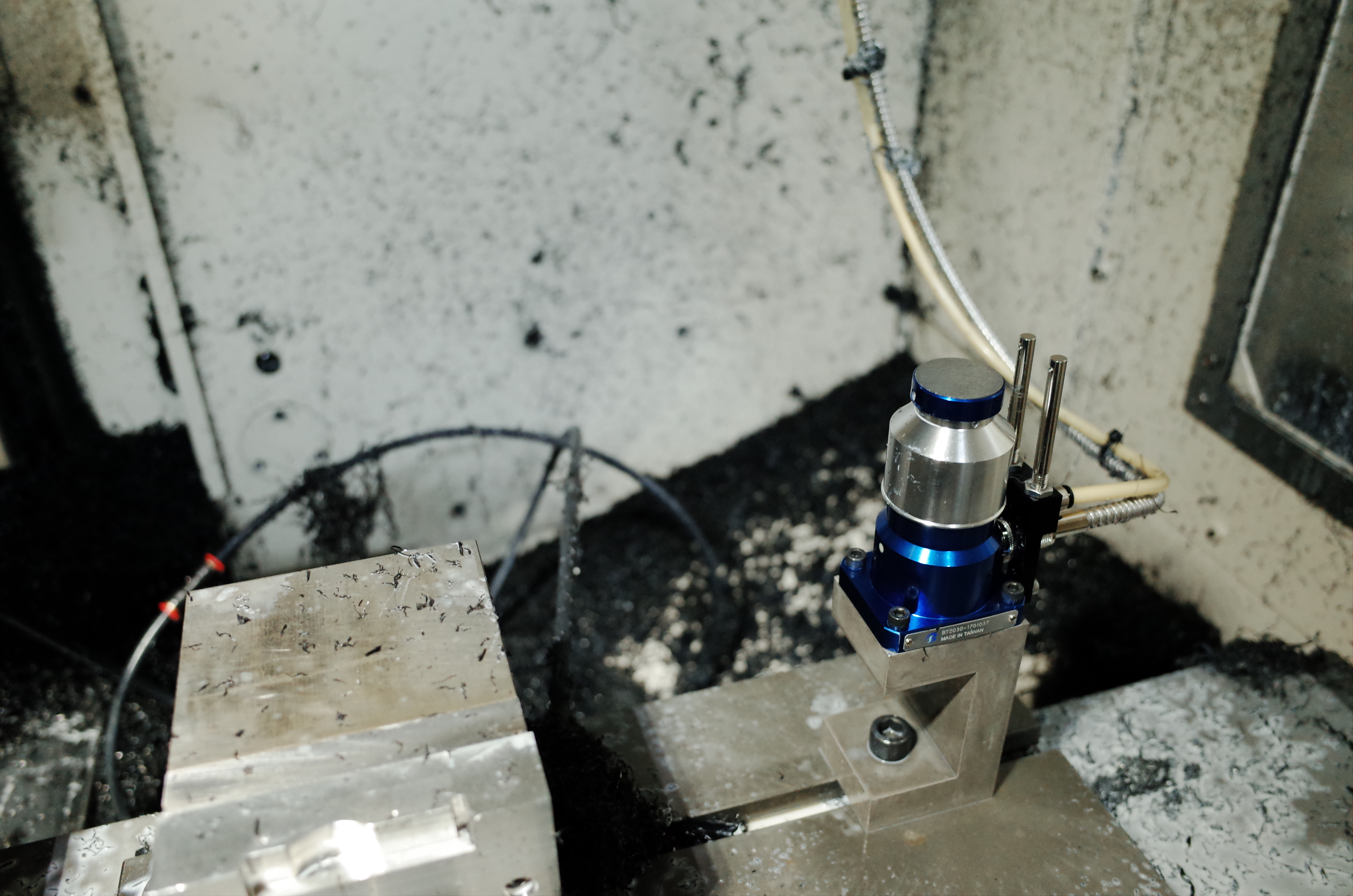
The T-SENSE tool setter employs a cylindrical housing design—colloquially nicknamed the “Yakult can” in the industry. Internally, it dispenses with mechanical amplification mechanisms in favor of a high-precision contact sensor and electronic circuitry, representing an electro-mechanical integrated design.
2. Readout Method and Human Error
The Z-axis presetter relies entirely on the operator visually observing the relative position between the pointer and the graduated dial. This process is highly susceptible to errors arising from insufficient operator training, fatigue, or viewing angle (parallax). Even for experienced technicians, repeatable interpretation accuracy remains constrained by human ergonomics and scale resolution.
The T-SENSE tool setter fundamentally eliminates human interpretation errors. In its automated configuration, the CNC controller directly receives the trigger signal and performs fully automatic tool length measurement. Even the manually operated version is equipped with a high-brightness LED indicator:
- The indicator illuminates instantly when the tool reaches the preset height
- Provides a clear, unambiguous arrival signal
- The binary on/off readout is completely unaffected by viewing angle or subjective judgment
3. Measurement Accuracy and Resolution
Accuracy is the most critical difference between the two. The traditional Z-axis presetter’s mechanical indicator typically offers a minimum scale resolution of 0.01mm. Constrained by gear backlash, friction, and mechanical hysteresis, even its top-tier repeatable positioning accuracy reaches only +/-0.02mm.
The T-SENSE tool setter, benefiting from its high-rigidity bearing guidance system and sensitive electronic sensing elements, delivers repeatable measurement accuracy of up to 0.0006mm (i.e., 0.6um). This accuracy enters the micron realm, fully satisfying the stringent requirements of high-precision machining such as optical mold and micro-mechanical component production.
Accuracy Gap Quantified: The T-SENSE tool setter’s repeatability (0.6um) is over 30 times better than a traditional Z-axis presetter (20um). This is not an “improvement”—it is a fundamental generational leap in precision grade.
4. Operational Efficiency and Automation Integration
The two technologies exhibit a significant gap in tool setting operational efficiency. A traditional Z-axis presetter requires the operator to manually execute the following complete workflow:
- Slowly lower the tool
- Observe the pointer reaching the target position
- Lock in the reading
- Retract the tool in reverse
The entire tool setting cycle typically consumes several minutes, with the process heavily dependent on operator feel and sustained attention.
The T-SENSE tool setter, in its automated integration mode, works in coordination with the CNC controller’s automatic tool setting macro program. The tool rapidly approaches, automatically decelerates before contact, and once the signal triggers, the controller instantly records the tool length offset value. The entire process for a single tool is completed in approximately 10 seconds.
Productivity Impact: This efficiency advantage becomes particularly pronounced in machining schedules involving dozens of tools—for 30 tools, each tool change and setting cycle saves over 1 hour, substantially reducing machine idle time.
5. Environmental Tolerance and Protection Rating
This is the fundamental differentiator in field application reliability between the two.
The traditional Z-axis presetter is a precision mechanical measuring instrument, highly sensitive to its environment:
- The gear mechanism has no sealing design, completely incapable of resisting cutting fluid, dust, or oil mist intrusion
- Once exposed to moisture, internal rust and mechanical binding can occur
- Must be stored in a wooden protective case within a temperature- and humidity-controlled metrology room when not in use
- Only brought to the machine by a technician when tool setting is needed
- If dropped or impacted during transport, the delicate internal gears and bearings are easily damaged or deformed, leading to measurement baseline drift or even total failure
The T-SENSE tool setter is purpose-built for the harsh conditions of the CNC machining environment:
- The unit features a waterproof and dustproof sealed structure
- Can be permanently mounted on the machine table
- Directly withstands cutting fluid splash, metal chips, and airborne grinding dust
- Internal mechanism operation and electrical insulation performance remain unaffected
- Serves as a permanently deployed part of the machine, eliminating risks associated with repeated dismounting, transport, and remounting
6. Long-Term Stability and Maintenance Requirements
The core problem with traditional Z-axis presetters lies in their mechanical transmission mechanisms:
- The internal gear assemblies, after prolonged use, develop wear and increased backlash
- Cutting fluid infiltration causes lubrication failure and seizing
- Spring metal fatigue results in preload drift
- Consequently, periodic height calibration and internal cleaning and maintenance are essential; otherwise the measurement baseline will gradually drift
The T-SENSE tool setter’s internal actuation mechanism employs a precision linear bearing that achieves near-frictionless axial motion. This design completely eliminates the backlash and interference seizure issues inherent in gear transmission, maintaining excellent mechanical repeatability over long-term use and ensuring every tool setting signal triggers at the same height position, substantially reducing calibration frequency.
7. Tool Adaptability and Sensitivity
This is the broadest divide in application scope between the two technologies. Due to the internal spring preload and inertia of moving parts in a Z-axis presetter, its contact trigger force is relatively high—rendering it incapable of measuring micro tools.
The T-SENSE tool setter features exceptionally high triggering sensitivity with extremely low trigger force:
- The standard version can safely measure micro drills and end mills with diameters as small as 0.07mm
- For special requirements, custom-spec models can measure ultra-fine tools with diameters of just 0.05mm
- At such minute scales, the contact force of a traditional Z-axis presetter would instantly cause tool fracture or bending deformation, rendering it completely incapable of performing such measurement tasks
Field Validation: T-SENSE tool setters have been proven through actual testing to reliably measure ultra-micro tools down to 0.05mm. View the complete 0.05mm tool setter test report →
Summary
The T-SENSE tool setter is not merely an improved version of the Z-axis presetter—it is a cross-generational product based on fundamentally different physical principles. It elevates tool setting from the analog era—dependent on visual interpretation, mechanical structures, and meticulous care—into the digital era of signal output, micron-level precision, waterproof and dustproof construction, permanent on-machine installation in harsh machining environments, and seamless automation integration. This fundamental design philosophy difference makes it the critical equipment for boosting utilization rates and machining accuracy in modern CNC production lines.
Frequently Asked Questions
Upgrade Your CNC Production Line's Tool Setting Solution
Contact T-SENSE today. We will recommend the most suitable tool setter products based on your machine model and machining requirements.
Contact Us for Expert Consultation